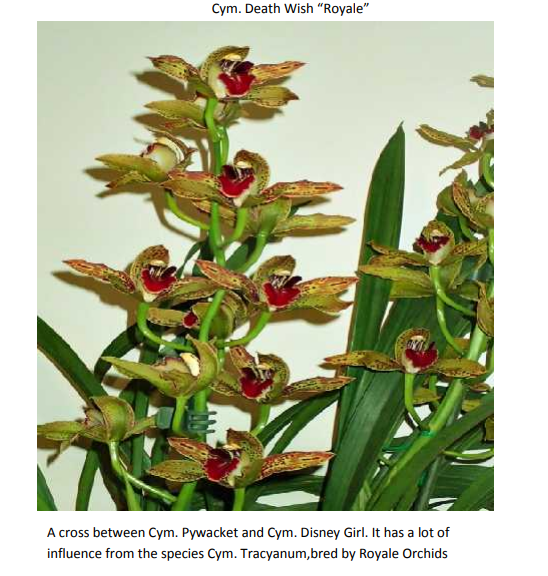
This rather different orchid was Best of the Evening Hybrid at Kuringai’s June 2016 meeting. I have always liked the “different” orchids, and boy, is this one different. It is a stunner and came from virtually our own backyard. It was created by Kevin Hipkins of Royale Orchids up at Peats Ridge, just outside Sydney.
Death Wish is a really interesting cross. The parents are Cym. Pywacket and Cym. Disney Girl, each of which contains 50% of that wonderful species Cym tracyanum, and the tracyanum influence dominates.
Tracyanum has a striking flower with a nice upright spike and about 15 (12cm) flowers. The flowers have somewhat narrow segments but are boldly coloured with red stripes on a cream to green background. Another unique and pleasing character is its unusual perfume which smells very similar to apricot fruit.
You will often see this species name spelled “traceyanum” with an “e” which is not correct. The species was named in honor of its owner Mr. H A Tracy. It was first described as a species in the Gardeners’ Chronicle of 20 December 1890 and the name Death Wish ‘Royale’ was published as Cymbidium tracyanum. Unfortunately, the following year, in Williams’ Orchid Grower’s Manual, the description of the species appears again but with the owners name given as A.H. Tracey and the plant name given as Cymbidium traceyanum. Williams work was later copied by Veitch in his Manual of orchidaceous Plants (1893), and as these two publications were regarded as the bible by orchidists, the error was subsequently proliferated. (reference : http://www.orchids.it/il-genere-cymbidium/ )
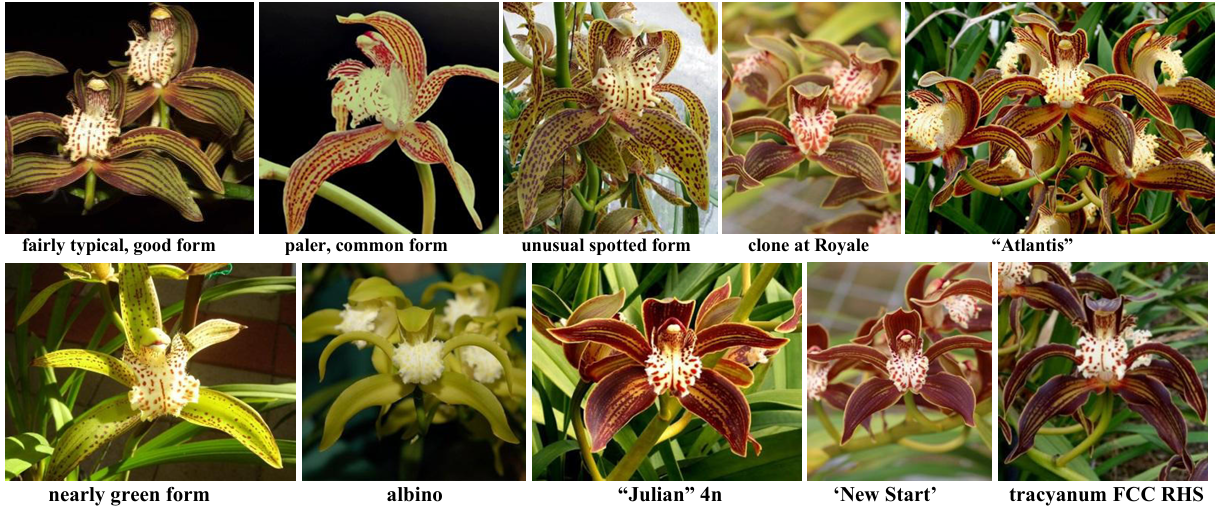
Like most species, the colours in tracyanum can vary a bit and I have seen many different individuals during the 40 years I have been growing orchids. The most popular always seem to be the ones with darker colours – usually having a more intense green background and darker red stripes, but there are many variations. The most common types seem to be the paler ones with a more yellowish cream background and paler red stripes. But, when I did a bit of research for this article, I must admit that I was quite surprised at just how different some of them can be.
I am only guessing, but based on what I have seen over the years, I think that some of the current very dark forms are the result of man made line breeding, and even artificial chromosome doubling, but that doesn’t mean they all are. There are certainly records of very different forms going way back before man started playing his laboratory games.
In the small gallery below, I have borrowed a few pictures from the internet to show you some extent of today’s variations within the species. When you see some of these newer types, it is easy to see where the inspirations for eye catchers like Death Wish came from, but I would never have imagined it in all the years I have grown tracyanum.
( 10 different clones of tracyanums ↓ )
fairly typical, good form paler, common form unusual spotted form clone at Royale “Atlantis”
However, getting back to Death Wish, lets look more closely at its parents – Disney Girl and Pywacket. Both were developed by Andy Easton’s Geyserland Orchids in NZ but were registered in California. Disney Girl by Mrs Patrice Gomes in 1992, and Pywacket by Eleanor Caughlan of California in 1996.
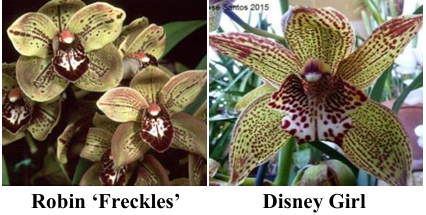
Disney Girl’s parents are tracyanum and “Robin”. We can never know which clones were used, but as you can see from the pictures at the right, Robin ‘Freckles’ Disney Girl Robin was an unusual cross in itself with an almost petaloid appearance and strong speckling in all segments. The introduction of tracyanum didn’t improve the shape but seems to have intensified the spotting, and Disney Girl is certainly an attractive orchid in its own right.
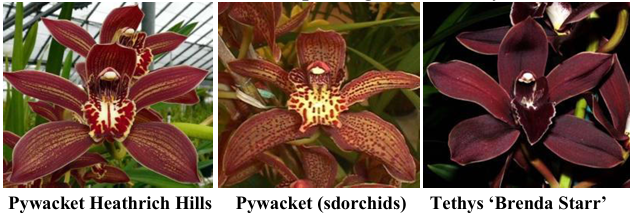
Pywacket is another “different” orchid. Its parents are Tethys and tracyanum. Tethys was famous in its day for the dark colour of many clones, and it’s very dark lips. It was bred from earlier dark red Cymbids like Khyber Pass, and Volcano. Again, we don’t know which clones the hybridist used, but the samples at the right give you Pywacket Heathrich Hills Pywacket (sdorchids) Tethys ‘Brenda Starr’
a fair idea of what was involved. “Brenda Starr” was maybe the darkest of the Tethys but most had that fantastic full red lip you see in Brenda Starr. I would imagine that crossing Tethys with tracyanum might have been expected to intensify the red colours before further crosses were used to improve shape, but I am only guessing. Perhaps Mr Easton had already imagined the wonderful dark, spotty, but open flowers that Pywacket delivered.
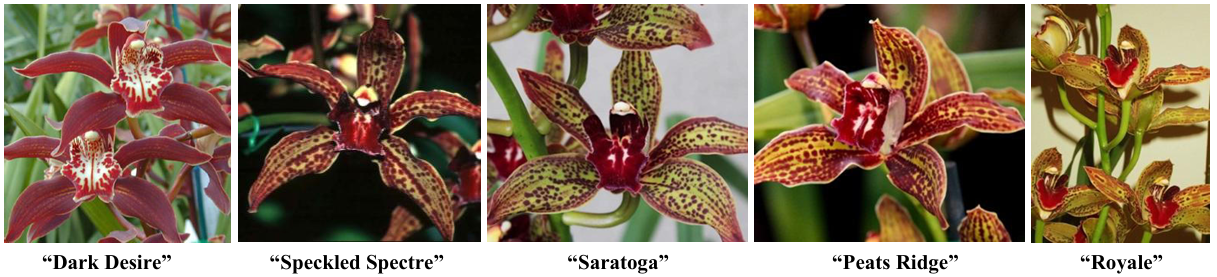
Combining Pywacket and Disney Girl was a stroke of genius we can thank Kevin Hipkins for, and he certainly didn’t do it to get a full round shape standard Cymbidium. Since Death Wish was registered in 2001, it has been a sensation and growers could hardly get enough of it. There have been 4 clones given awards. “Tiger Jade” and “Peats Ridge” have an HCC, “Royale” and “Speckled Spectre” have an AD. I can’t find a picture of Tiger Jade but here are 5 clones to show some of the range. However, I must warn you that in looking at pictures of the clones, there has been a huge colour and pattern variation within supposed pictures of the same clone. Whether this is due to growing in different conditions such as brighter light or more shade, or just the photography, I can’t say. Just be aware that if you buy one, it may not flower for you exactly the same as these pictures.
I am not sure whether I should call it the “Death Wish genre” or perhaps the “Pywacket genre”, (which came first, the chicken or the egg), but this genre has sparked a range of similarly ‘different’ orchids that I am sure many growers find irresistible. I had intended to go on and discuss more of the kind, but I have just about used up my colour picture space allowance this month in this one piece so perhaps I will reserve that for next time.
note: Williams Orchid Growers Manual Edition 7 can be read online at biodiversitylibrary – just google the book name
Download Artical In PDF Download Here

